Showing posts with label Heel pain. Show all posts

Monday, June 16, 2014

Will 3D custom foot orthotics help you?


Orthotics are devices that are placed in the shoe to put the foot in a neutral position, or provide cushioning depending on the type of orthotic.  Orthotics devices are used in foot conditions such as, flat foot, pes cavus (high arched feet), equinus (muscular imbalance limiting upward motion of foot), hammertoes, limb length difference, diabetes, bunions and many other conditions.  Orthotics can be custom made or bought over the counter.  A 3-dimensional scan of the foot is used to send to a lab that makes custom made orthotics, and the orthotics lab can add correction specific to the patients’ needs based on specific instructions in the form of a prescription from our offices.

Orthotics fall into two different categories: functional and accommodative:  

Functional orthotic devices are used to correct biomechanical deformities in the frontal plane, and reduce impact while running or walking.  Functional correction is used to reduce abnormal pronation by providing support of the arch, while accommodative orthotics are a soft supportive device used to provide cushioning, and distribute weight bearing pressures evenly across the bottom of the foot.  When making orthotics it is important to compensate for limb length differences because even a small difference can cause pathology, and affect gait.  Symptomatic differences in limb length usually occur when there is a 4cm or greater difference.  Functional orthotics devices are made of semi-rigid material to provide stability, such as graphite or plastic.  

Accommodative orthotic devices are usually made of softer materials, such as leather or foam to provide comfort.  Accommodative orthotics devices are used in conditions such as diabetes and rheumatoid arthritis to help relieve pressure and apply gentle offloading forces away from prominent structures of the foot. 


This is just a brief overview of the various uses and types of orthotics, and is not complete by any means.  For some people, orthotics devices are a way to treat foot pain conservatively and avoid surgery.  Orthotics devices are sometimes recommended post-operatively to prevent recurrence of various deformities.  However, some patients use orthotics devices to provide stability and support to the foot, and prevent injuries.  

Here, we have a 3-dimensional scanner which can allow us extremely accurate impressions of the feet in order to achieve both optimal comfort and control with our custom molded devices. 


Orthotics, also known as orthoses, refers to any device inserted into a shoe, ranging from felt pads to custom-made shoe inserts that correct an abnormal or irregular, walking pattern. Sometimes called arch supports, orthotics allow people to stand, walk, and run more efficiently and comfortably. While over-the-counter orthotic are available and may help people with mild symptoms, they normally cannot correct the wide range of symptoms that prescription foot orthoses can since they are not custom made to fit an individual's unique foot structure.

Orthotic devices come in many shapes, sizes, and materials and fall into three main categories: those designed to change foot function, those that are primarily protective in nature, and those that combine functional control and protection.
Rigid Orthotics
Rigid orthotic devices are designed to control function and are used primarily for walking or dress shoes. They are often composed of a firm material, such as plastic or carbon fiber. Rigid orthotics are made from a 3-dimensional scan of the foot or feet. Rigid orthotics control motion in the two major foot joints that lie directly below the ankle joint and may improve or eliminate strains, aches, and pains in the legs, thighs, and lower back.

Soft Orthotics
Soft orthotics are generally used to absorb shock, increase balance, and take pressure off uncomfortable or sore spots. They are usually effective for diabetic, arthritic, and deformed feet. Soft orthotics are typically made up of soft, cushioned materials so that they can be worn against the sole of the foot, extending from the heel past the ball of the foot, including the toes. Like rigid orthotics, soft orthotics are also made from a 3-dimensional scan of the foot.
Semi-Rigid Orthotics
Semi-rigid orthotics provide foot balance for walking or participating in sports. The typical semi-rigid orthotic is made up of layers of soft material, reinforced with more rigid materials. Semi-rigid orthotics are often prescribed for children to treat flatfoot and 
in-toeing or out-toeing disorders. These orthotics are also used to help athletes mitigate pain while they train and compete.

If there is any question whether these sorts of devices may help you, most likely than can, because if you are questioning if you need them most likely your feet have some symptomatic concern which does require an evaluation.


Brian Timm, DPM, FACFAS

Board Certified by the American Board of Podiatric Surgery

Monday, June 2, 2014

Masses on your foot


There are many types of tumors that affect the foot, and many are benign.    

Two of the most common types are ganglion cysts and plantar fibromas.  

Ganglion cysts are also known as bible cysts because common treatment was hitting them with a bible so that the cyst would burst.  Ganglion cysts are more common in younger people, while plantar fibromas are more common in older people.  
Ganglion cysts often occur on the top of the foot, but are also very common on the hand.  The cysts are fluid-filled, occur at joints, and often change size. Ganglion cysts are usually observed for any changes unless they reach a size that causes pain or pressure on nerves or arteries.   Immobilization of the area is also sometimes helpful because activity often causes the cyst to increase in size.  If they reach a large size, then further treatment may be beneficial.  Further treatment of ganglion cysts usually consists of draining the fluid with a needle, or aspiration.  Aspiration of the fluid is not always successful because the root of the cyst may remain, and the cyst will return.  Surgical treatment may be recommended for recurring ganglion cysts. 


Plantar fibromatosis is the most common benign tumor on the bottom of the foot.  Plantar fibromatosis is also known as Ledderhose’s disease, which is a thickening of the foot’s plantar fascia.  Over time the lump increases in size, and may start causing pain or limitations in activity.  This type of benign tumor is often associated with a family history of the disease, or patients with diabetes.  Initial treatment is off-loading to avoid direct pressure or worsening of the tumor.  Corticosteroid injections and cryotherapy are often used initially before surgical options are considered.  Surgical removal of a plantar fibroma is more difficult than removing a ganglion cyst, which is why more conservative therapy is recommended unless conservative methods have failed. 
Ganglion cysts and plantar fibromatosis are only two of many types of possible tumors, but they are the most common benign tumors presenting in the foot.  These are both very manageable conditions, but with any lump or bump in the foot it is important to see your Podiatrist to rule out something more serious.

Brian Timm, DPM, FACFAS
Diplomate: American Board of Podiatric Surgery
Board Certified in Foot Surgery

Tuesday, March 18, 2014

Secrets of Chronic Achilles Pain


1) NOT all posterior heel pains are tendon problems.

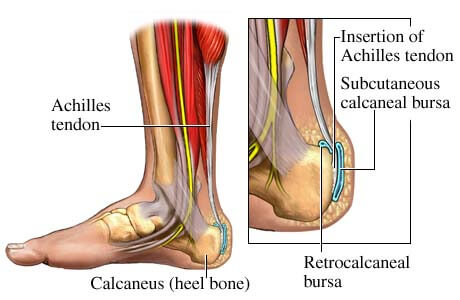
We will provide a thorough examination, which includes diagnostic ultrasound, radio graphs, and clinical exam with history taking to provide the best possible outcome for your pain. There are several other structures which are present and could be treated in a different manner than any straight forward Achilles tendinitis.  Noted above, there is a bursa which is present here and can often be the root cause of pain secondary to bursitis. This is treated differently than Achilles tendinitis. This may also require MRI to determine how much of the inflammation is related to bone versus soft tissue. Additionally, and more rarely, a stress fracture can cause this pain in the calcaneus. This is not common but we check for this as well.

2) Tendon tears do NOT always require surgery.

After clinical examination and proper staging/grading of the extent of the tear, we have had success in treating Achilles partial tears and even ruptures non-surgically in select patient populations. We have a variety of techniques at our disposal in order to facilitate the healing process if surgery is not indicated. In the case of chronic tears there are several nonsurgical treatments that work, particularly PRP injections, High energy shock-wave treatments, and even physical therapy with anti inflammatory ultrasound.

3) Bone spurs are NOT always relevant. 

Often times patients will state that they "Have had a spur in the past but it went away". Usually any bone protuberance which is either palpable or visible on a plan radio-graph or MRI will NOT go away spontaneously ever and always if indicated will need resection if it is the root cause of the symptoms. In most cases the spur is not the root cause of the symptoms, and is not required to remove it, but there are far too often very large spurs which are not even symptomatic that are visible on X-ray examinations in many of our patients, therefore backing up further the concept that bone spurs are not always the real problem.

Bio-mechanically a bone spur will exist in areas of either repeated chronic trauma, or areas of chronic taut insertions. Rarely is this an isolated tumor of bone, and that being said, it is often not necessary to remove the bone spur.


Dr Timm

Board Certified by the American Board of Podiatric Surgery

Monday, March 10, 2014

Secrets of Recurring Heel Pain


Many patients are becoming even more active with age, and as this new generation of elderly patients become our community's senior citizens we are finding out more often that you are only as young as you feel. With this, there are different aches and pains, and they are more common and can be restricting towards maintaining this level of leisure. Above all other pains common to the foot and ankle, heel pain is by far the most common. Sometimes, we will be a 3rd and 4th opinion to attempt to remove this nuisance from our patient's feet. Most often heel pain is treated by cortisone injections, physical therapy, weight loss, and orthotics. 

But what about the patients who have been there and done that?

There are few treatments that are more promising in the field of heel pain management with more potential than the
Extra Corporal Shockwave Therapy for very tough heel pain. A good overview of the proposed mechanism for how this works involves using devices that generate pulses of high-pressure sound that travel through the skin and yeild natural repair from the tissues and increased blood flow networks to damaged tissues. 

For reasons that are not fully understood, soft tissue and bone that are subjected to these pulses of high-pressure energy heal back stronger and without causing further damage to the tissues like repeated cortisone injections may do. 

The FDA has approved the use of some ESWT machines for heel pain and tennis elbow. ESWT devices evolved from lithotripters (a.k.a. kidney stone shock wave machines). The discovery of the beneficial effects of ESWT came as German researchers were trying to determine what type of high-pressure pulses could be sent through the body to disintegrate kidney stones without causing harm to surrounding tissue. In laboratory animals and humans, it was discovered (with some surprise) that surrounding tissue would often heal back stronger and this applies well to our topic of heel pain. 

Physical therapists use ultrasound machines that warm internal tissue by high frequency sound waves, but the ESWT machines send higher-energy pulses 2 or 3 times per second rather than continuous lower-energy waves. Electricity is not sent into the body. It may take as long as 5 months to see the full benefit of an ESWT treatment. The beneficial effect of the high-pressure waves may be from the growth of new blood vessels ("neovascularization") in small cavities that are created by the pulses. New blood vessels to an area of tissue would promote healing either directly or indirectly by providing additional growth factors to the area of concern by way of new vascular channels.

Some studies have even shown this therapy to be equivalent to a fasciotomy, which is an invasive procedure that involves an incision to sever the medial fibers of the fascia for reduced pressure and tension on the inferior heel bone. This means that you can get equivalent results without the complications of a minor procedure. We provide 2 variations of the ESWT, a high energy and a lower energy, and each has benefits that have been shown to work well on difficult heel pain. Either method will be beneficial to our patients, and if you are limping in the AM, or have trouble walking after a brief rest from activity because your heel is holding you back, you should consider a consultation with one of our doctors.

Dr Timm
Diplomate: American Board of Podiatric Surgery
Fellow: American College of Foot and Ankle Surgery